MARISSA PARROTT, HANNAH SLY, ESTELLE VAN HOEYDONCK & HUGH LEITWELL
Zoos Victoria
In past years, Bogong moths (Agrotis infusa) have swarmed Parliament House in Canberra, crashed the opening ceremony of the Sydney 2000 Olympics and even blocked out the stars and Moon while flying overhead on their annual migration from southern Queensland, NSW, the ACT, and western Victoria to the Australian Alps in spring, and also while returning in autumn.

The moths are crucially important to our ecosystems, pollinating native plants along their migratory path, and bringing the second biggest influx of nutrients into the alpine zone each year.[1] But their numbers have been declining due to many factors, particularly the increasing impacts of climate change. We need to know a lot more about their habits, and the timing and routes of their travels. And everyone can play a part.
The 1000km Migration To The Alps
Bogong moths migrate up to 1000 km to spend their summers in the cool caves and boulder-fields of the Victorian Alps. To navigate along the way, they use the stars as a map,[2] together with the Earth’s magnetic fields.[3] This migratory behaviour is remarkably impressive for a species that measures only 2.5 to 3.5 cm long (about the size of a 50-cent piece) and weighs a third of a gram (less than a Tic Tac).
Their safe arrival is vital for the health of alpine soils, plants and animals. They are a key spring food source each year for the critically endangered mountain pygmy-possum (Burramys parvus), Australia’s only mammal found exclusively in the alpine zone. The moths begin their migration just as the mountain pygmy-possums are waking up from their annual hibernation of between five and seven months under the snow. During this time the possums lose up to half their body weight. They rely on the moths as a protein and energy-rich meal during spring when females are busy raising litters of up to four young.[4]

Once numbering billions, these extraordinary moths have been in decline since the 1980s due to many threats; including habitat destruction, changes in agriculture, the use of toxic insecticides and herbicides, and light pollution. Between 2017 and 2019, their population collapsed by an estimated 99.5 per cent, most likely due to severe drought in southeastern Australia.[5] Across all monitored Victorian mountain pygmy-possum populations, more than half of the female possums lost their entire litters of young.[6]
Moth Tracker – citizen scientists come to the rescue
This disaster prompted the beginnings of Moth Tracker, a citizen science program, in 2019 [7]. It is difficult to track a tiny, well-camouflaged, nocturnal animal across long distances. Citizen science can make all the difference.

Zoos Victoria is calling on the Australian public to help track Bogong moth migratory paths, learn more about their numbers and trends between years, and find their important breeding grounds for protection into the future.[8] Moth Tracker also helps as an early detection system for those years when moth numbers are low and the mountain pygmy-possums may need extra support to gain weight and raise their offspring.[9] Every sighting logged on the Moth Tracker website helps scientists understand more about the species. And this assists in providing better protection and recovery in future.
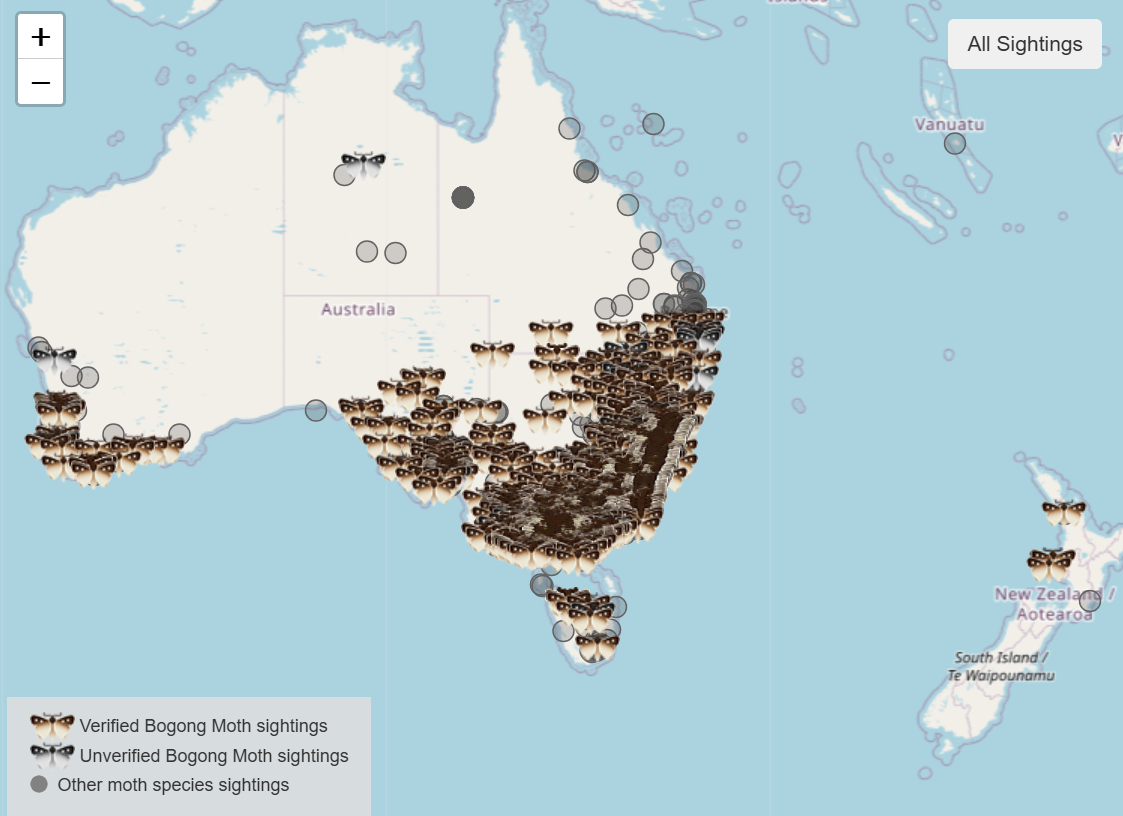
The numbers of Bogong moth sightings recorded on Moth Tracker have been increasing since its inception and appear to match closely the data collected by scientists monitoring known moth-caves. Verified Bogong moth sightings have been received from every Australian State and Territory, except the NT (which is probably too hot and humid for these moths)[10]. Sightings have dipped in some years, likely due to inclement weather, but in 2024 and 2025, larger swarms were seen, particularly in NSW, the ACT, and the Alps.
This spring, numbers are even higher. In fact, more sightings were submitted on Moth Tracker in the last weekend of September 2026, than during the entire spring migration of 2025! While numbers have been looking healthier in NSW and the ACT since 2025, numbers in Victoria have been comparatively lower, with migration dates to the Alps and back towards the breeding grounds appearing to be later in the season. This may be due, in part, to the ongoing hot and dry conditions in western Victoria. It highlights the importance of Moth Tracker in Victoria and right across Australia, to determine the factors impacting Bogong moths (and the mountain pygmy-possums), so action can be taken to assist their protection and recovery.
Excitingly, you do not need to travel to remote areas to find Bogong moths. They will come to you. They can be seen in your backyard, at home, work or in other locations as they make their migration.
How can you help?
If you think you’ve seen a Bogong Moth, take a photo and upload it to the Moth Tracker website to have it verified by an expert and added to Zoos Victoria’s interactive map. Bogong Moths have been recorded everywhere in Australia except the Northern Territory, and occasionally are blown by strong winds all the way to New Zealand. You can check back on the map to see if your sighting was a Bogong moth, and look at other sightings in your area and further afield.
Remember to turn your outside lights off at night! Unnecessary light can draw moths away from their migration and into the path of other dangers. Turning off lights can help them continue on their way. This assists other local wildlife.
If moths are found indoors, do not hurt, kill, or spray them with insecticides. They are gentle animals that do not bite, eat clothes, or cause any damage. In fact, they are important pollinators and crucial for the environment. Gently collect them and place them outside in a dark, safe location to continue on their way. The moths will move on by themselves.
Please plant native flowering plants including grevilleas, eucalypts, callistemons, heath and more. These will provide nectar for migrating moths and food and shelter for other local wildlife.
What should you be looking for?
Bogong Moths are only around 2.5 to 3.5 cm long with brown-grey wings.
They have distinctive markings: a dark band that runs vertically along each wing intersected by two beige splotches; the lower splotch is shaped like a kidney.
The moths may appear individually or in large swarms when conditions are good.
For more information on Moth Tracker, check out the website: zoo.org.au/moth-tracker
References
[1] Green, K. (2011) The transport of nutrients and energy into the Australian Snowy Mountains by migrating bogong moths Agrotis infusa. Austral Ecology 36: 25–34. doi:10.1111/j.1442-9993.2010.02109.x
[2] Dreyer, D. et al. (2025) Bogong moths use a stellar compass for long-distance navigation at night. Nature 643: 994–1000. https://doi.org/10.1038/s41586-025-09135-3
[3] Warrant, E.J. et al. (2016) The Australian Bogong moth Agrotis infusa: A long-distance nocturnal navigator. Frontiers in Behavioral Neuroscience. 10, 77. doi.org/10.3389/fnbeh.2016.00077
[4] Gibson, R.K. et al. (2018) Susceptibility to climate change via effects on food resources: the feeding ecology of the endangered mountain pygmy-possum (Burramys parvus). Wildlife Research 45: 539–550. doi:10.1071/WR17186
[5] Green, K. et al. (2021) Australian Bogong moths Agrotis infusa (Lepidoptera: Noctuidae), 1951–2020: decline and crash. Austral Entomology60: 66-81. https://doi.org/10.1111/aen.12517
[6] DEECA (2019) Mountain pygmy-possum operational contingency plan. Department of Energy, Environment and Climate Action. Victorian State Government. https://www.environment.vic.gov.au/__data/assets/pdf_file/0028/441559/MPP-Operational-Contingency-Plan-2019-20.pdf
[7] Parrott, M.L. et al. (2024) Moth Tracker: citizen science to help the endangered Bogong moth and critically endangered mountain pygmy-possum. Science Victoria 4 (6): 31-35
[8] Carruthers D, et al. (2020) Migrating moths and alpine possums: Mobilising community across Eastern Australia. International Zoo Educators (IZE) 2020: 18-25
[9] Parrott, M.L. et al. (2020) Looks like an ANZAC biscuit, tastes like a protein bar: Bogong bikkies help mountain pygmy-possums after fire. The Conversation. https://theconversation.com/looks-like-an-anzac-biscuit-tastes-like-a-protein-bar-bogong-bikkies-help-mountain-pygmy-possums-after-fire-131045
[10] Moth Tracker: zoo.org.au/mothtracker
Other articles of interest







Discover how you can join the society
Join The Royal Society of Victoria. From expert panels to unique events, we're your go-to for scientific engagement. Let's create something amazing.