Trickles and torrents: How climate change is affecting Melbourne’s waterways
Science Victoria Edition


Geography Victoria, The University of Melbourne, Alluvium Consulting
Melbourne Water, The University of Melbourne
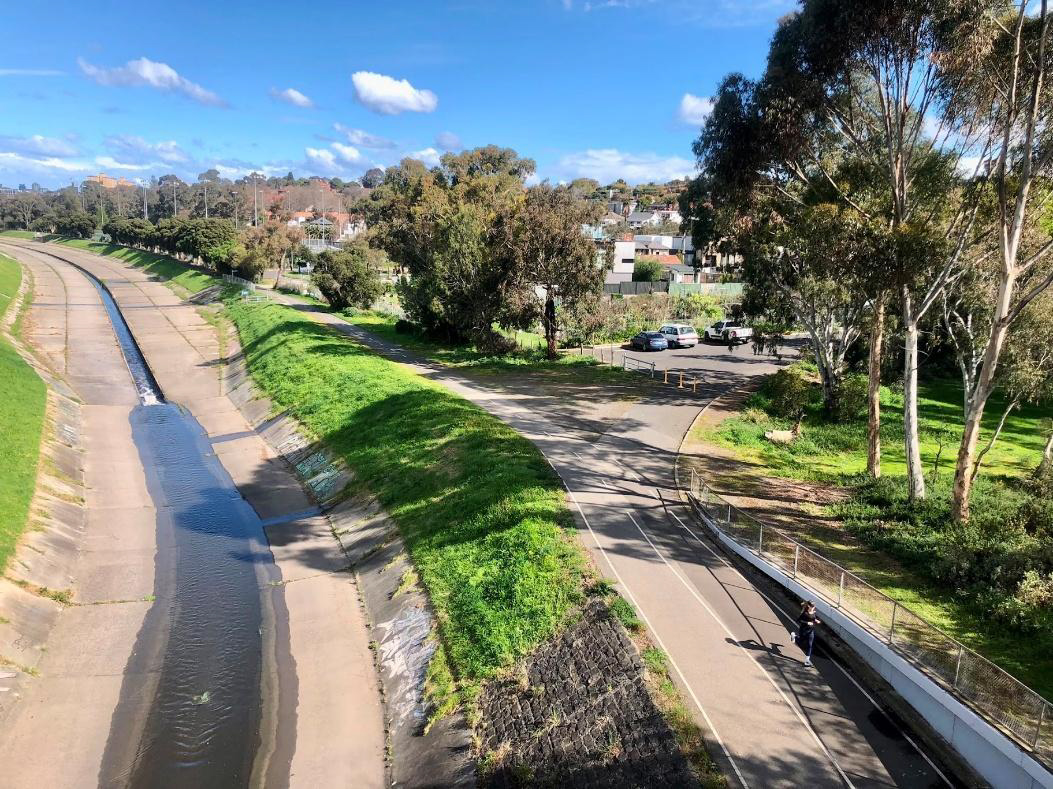
As urbanisation of the catchment has increased, many of Melbourne’s streams have been modified to manage flood risks. Creeks have been straightened and channelised as floodplains have become progressively covered by dense development. And the impact of urban storm water on animals and water quality – such as increasing turbidity and litter – has been huge.
So the influence of climate change on Melbourne’s creeks and rivers is superimposed on the existing and continuing urbanisation of their catchments.
Geography Victoria recently held a field trip to visit some of Melbourne’s urban streams. What participants saw was typical of globally recognised impacts of urban stormwater on streams – ‘urban stream syndrome’ as it is termed in Walsh et al. (2005) [1]
The rise of Impervious Surfaces
Roofs, roads and other impervious surfaces, particularly those directly connected to waterways by pipes – directly connected imperviousness (DCI) – rapidly deliver stormwater to streams. Before, much of that water would have infiltrated through the soil or evaporated before reaching the waterway.
The result is that urban streams often experience more frequent and erosive high flows, but reduced groundwater-fed baseflows. These altered flows destabilise channels, simplify habitat and transport nutrients, sediment, metals and other contaminants into waterways. And these have seriously impacted aquatic life.
Heated impervious surfaces across the catchment can also influence thermal comfort and public health in cities during summer [2]. Runoff during these times can produce abrupt increases in stream temperatures[3].
In addition to these stormwater inputs, catchment urbanisation can also result in reduced space and connectivity for wildlife along waterway corridors.
Multiple ecological studies in Melbourne consistently show marked declines in ecosystem health at remarkably low levels of DCI (between 2% and 3%)[4]. In urban streams, biological communities typically become dominated by species that are tolerant of such pollution and disturbance. So simply restoring the channel or riparian (streamside) vegetation may do little for stream health, particularly if the principal cause, the catchment’s piped drainage system, is not addressed.
This was clearly demonstrated in the visit to Merri Creek during the field trip. The Merri Creek Management committee have transformed their creek from a highly modified drain to a densely vegetated corridor that provides huge benefits to communities. But the challenges to water quality and aquatic animals remain as urbanisation of the catchment increases.
Protecting and improving the health of our urban waterways is made more challenging as urban growth and associated housing developments progressively expand across the region. Estimates prepared for Infrastructure Victoria suggest that Melbourne’s urban area could grow by between 3.5% and 7% over the next 20 years.[5]

In addition, Melbourne’s streams are projected to face two increasing pressures from climate change over the coming decades: hotter, drier periods and more intense downpours.
Although urbanisation usually causes larger and more immediate alteration to the hydrology, water quality and physical condition of small urban streams, climate change increasingly modifies, and often magnifies this urban effect. In the urban and rural streams of the future, climate change may become the dominant pressure on water temperature, drought duration, and loss of perennial flow.
The effects of Urbanisation of Waterways
Lower flows and longer dry periods
Rainfall in the Maribyrnong catchment could decline by 22%, accompanied by an 11% rise in potential evapotranspiration [6]. Chee et al. (2023)[7] suggest that cool-season rainfall could decline, while evapotranspiration increases. Low flow runoff is expected to decline proportionally more than rainfall. Streams will experience: lower baseflows, longer periods of very low or zero flow, contraction of refuge pools, and poorer water quality.
Warmer water
Rising air temperatures, shallower low flows and longer dry periods may increase the average and maximum stream temperatures by up to 2oC according to Grey et.al. (2023).[3] There could be sharp thermal pulses when rain runs off heated roofs and roads. Warmer water can either directly or indirectly – for example, through less oxygen – increase stress on aquatic life such as fish, macro-invertebrates and platypus.
Floods
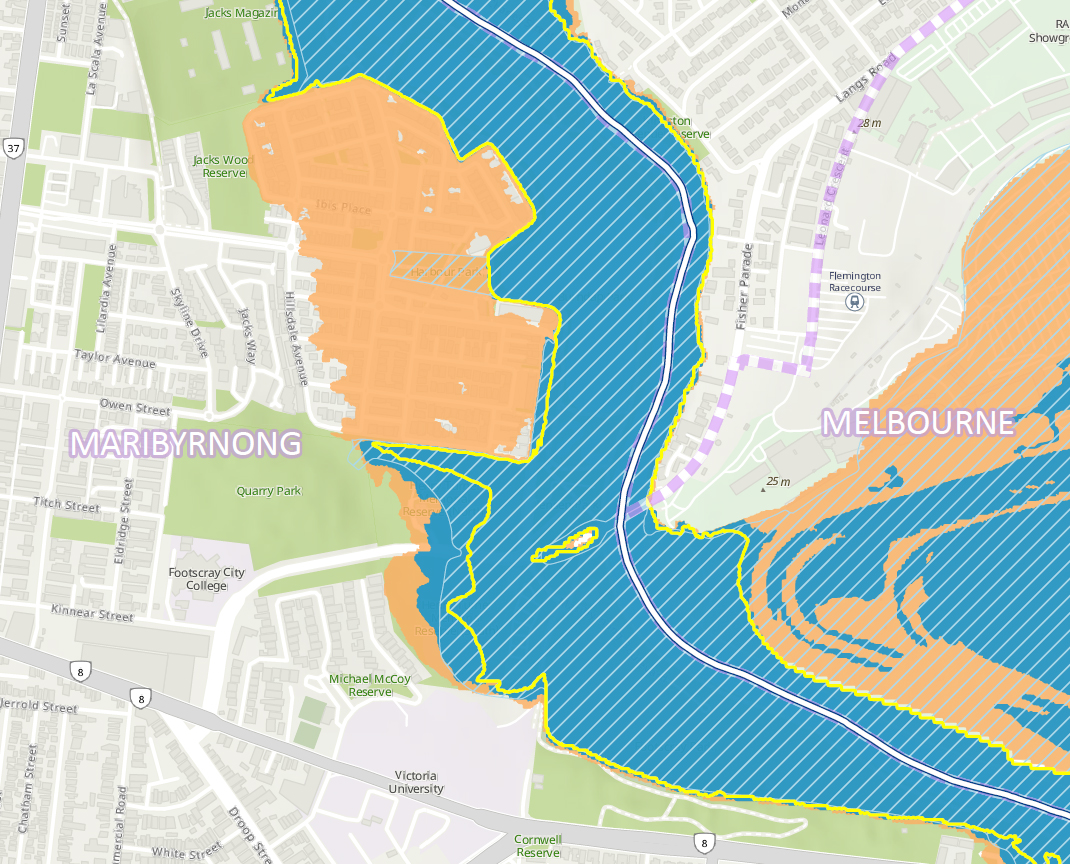
Climate change is projected to affect the magnitude of floods in Melbourne. The field trip visited the Maribyrnong River and saw the different historical flood levels, as well as the channelisation of the river in response to the 1934 flood. The severe flooding of this river in 2022 has focused interest back on reducing flood risks.
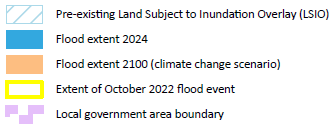
Although average rainfall and runoff are expected to decline, intense short-duration rainfall is projected to become heavier5. This is likely to increase flash flooding in the highly impervious urban catchments and place greater pressure on drains and small waterways. To support proactive planning, these forecast changes in large river floods are being investigated by Melbourne Water using climate projections. They suggest that greater areas will be inundated by higher floods by 2100.
Water quality reduction
A recent study shows the combined effects of urbanisation and climate change on water quality in the Maribyrnong catchment [8]. Hydrological simulations in that study suggest that stormwater discharge would rise by 16%, 31%, and 46% respectively with a 10%, 20%, and 30% increase in urbanisation. Climate change could further amplify runoff and pollutant transport because of more intense rainfall and higher evapotranspiration rates. Extreme combined scenarios indicated the potential for a three-fold increase in pollutant discharge to Port Phillip Bay.
There could be a range of impacts on water quality, such as increased delivery of catchment pollutants to waterways during storm events, decreased dilution of dry weather pollutants (discharges to drains during dry weather), and increased toxicity of some contaminants associated with changes in temperatures. Physical changes to temperature, dissolved oxygen and salinity will also impact aquatic life directly. A specific example could be that pollutants, organic matter and fine sediment accumulate in drains and channels during longer dry periods. The first substantial storm would subsequently deliver a more concentrated “first flush” of pollutants.
Biological Impacts
Drying across Melbourne’s streams is projected to substantially reduce suitable habitat for platypus and native fish (such as, river blackfish and ornate galaxias) by about 2070 [6]. A study by Coleman et al. published in 2022 [9] is unusual in that it explores the combined effects of urbanisation and climate change on platypus. The potential effects are complicated, affecting many aspects of their life-cycle. Although urbanisation has degraded platypus habitat around Melbourne – through changes in flow regimes, declines in water quality and loss of streamside vegetation, for example – the modelling suggests that climate change-induced reductions in streamflow will be the dominant future threat.
What to do about it?
To summarise, urbanisation historically has had a profound impact on waterways in Melbourne, and the risk of further change increases as the city grows. The impacts of climate change are superimposed on these effects, often amplifying them. The predictions are that Melbourne’s streams will become warmer and drier, but with more frequent floods. These hydrological impacts, where they continue to deviate from natural flow regimes, will further stress aquatic animals. So, without intervention, climate change is likely to lead to a decline in the condition of Melbourne’s streams.
What to do about this? Melbourne Water’s Healthy Waterways Strategy for Greater Melbourne [10] identifies a range of actions that can be taken over the next 10 - 50 years to protect and improve the health of the waterways of the region in the face of urban growth and climate change.
Stormwater harvesting, treatment, use and infiltration will be important in new and existing areas, as will be managing stormwater quantity in ways set out in the Healthy Waterways Strategy and new EPA Victoria stormwater management guidelines [11] . Riverbank shade and protection of stream flows, including wet refuges, are also expected to reduce urban and climate impacts on waterways.
Melbourne Water’s Flood Management Strategy for Port Phillip and Westernport 2021-2031 [12] was developed collaboratively with a range of partners, including the State and local governments, water authorities, and emergency services. It sets out opportunities for developing greater flood resilience under climate change and urbanisation. These actions include land-use planning, flood information, education, flood warnings, emergency response and recovery, as well as constructing, maintaining and upgrading drainage and flood management infrastructure.
Want to know more?
Subscribe to RSV for news and the latest Science Victoria subscribe.rsv.org.au
Join Geography Victoria's future field trips geogvic.org.au
References
[1] Walsh, C. J. et al. (2005). The urban stream syndrome: current knowledge and the search for a cure. Journal of the North American Benthological Society 24 (3): 706-723. https://doi.org/10.1899/04-028.1
[2] Jamei, E. & Tapper, N. (2019). WSUD and urban heat island effect mitigation.In A. K. Sharma et al. (eds.) Approaches to Water Sensitive Urban Design: Potential, Design, Ecological Health, Urban Greening, Economics, Policies, and Community Perceptions 381-407. Elsevier. https://doi.org/10.1016/B978-0-12-812843-5.00019-8
[3] Grey, V. et al. (2023). Empirical evidence of climate change and urbanization impacts on warming stream temperatures. Water Research 247: 120703. https://doi.org/10.1016/j.watres.2023.120703
[4] Walsh, C. J. et al. (2012). Urban stormwater runoff: a new class of environmental flow problem. PLOS ONE 7 (9): e45814. https://doi.org/10.1371/journal.pone.0045814
[5] The Centre for International Economics (CIE) (2023) Economic, Social, and Environmental Impacts of Alternative Urban Development Scenarios for Victoria: Final Report, prepared for Infrastructure Victoria. https://www.thecie.com.au/publications-archive/economic-social-and-environmental-impacts-of-alternative-urban-development-scenarios-for-victoria
[6] DELWP (2020). Victoria’s water in a changing climate. Department of Environment, Land, Water and Planning, Government of Victoria.
[7] Chee, Y. E. et al. (2023). Re-running habitat suitability models with updated climate-impacted projections and other scenarios of interest. Melbourne Waterway Research–Practice Partnership Technical Report 23.12.CIE https://mwhwsstorage.blob.core.windows.net/files/2024-12/Chee%20et%20al.%202023%20-%20Re-running%20HSMs%20with%20Climate-impacted%20Projections.pdf
[8] Moazzem, S. et al.(2026). Assessing the effects of urbanization and climate change on the stormwater quality in the Maribyrnong catchment, Australia. Frontiers in Sustainability 7: 1767452. https://www.frontiersin.org/journals/sustainability/articles/10.3389/frsus.2026.1767452/full
[9] Coleman, R. A. et al. (2022). Understanding and managing the interactive impacts of growth in urban land use and climate change on freshwater biota: a case study using the platypus (Ornithorhynchus anatinus). Global Change Biology 28 (4): 1287-1300. doi: 10.1111/gcb.16015
[10] Melbourne Water (2018). Healthy waterways strategy 2018-2028. Melbourne Water, Docklands, Victoria, Australia. https://www.melbournewater.com.au/about/what-we-do/publications/healthy-waterways-strategy
[11] EPA Victoria (2021). Urban stormwater management guidelines. Publication 1739.1, June 2021. Environment Protection Authority Victoria, Carlton, Victoria, Australia. https://www.epa.vic.gov.au/urban-stormwater-management-guidance
[12] Melbourne Water (2021). Flood Management Strategy for Port Phillip and Westernport 2021-2031. Melbourne Water, Docklands, Victoria, Australia. https://www.melbournewater.com.au/about/publications/strategies/flood-management-strategy-port-phillip-and-westernport-2021-2031\
[13] Banner image from ElenaEmeliya via Shutterstock
Other articles of interest






Discover how you can join the society
Join The Royal Society of Victoria. From expert panels to unique events, we're your go-to for scientific engagement. Let's create something amazing.