Unlocking the Secrets of Kimberley Rock Art: A Decade-Long Scientific and Personal Journey

Senior Research Fellow in Archaeological Sciences, University of Melbourne | Director of Research, RockArt Australia
When I first arrived in Australia 17 years ago from Manchester, fresh-faced and eager to begin my PhD in Earth Sciences at the University of Melbourne, I never imagined that my career would be defined by mud wasps, ancient sandstone, and long dry-season months spent in one of the most remote corners of the globe.
Back in 2010, my focus was purely geological—I worked on stalagmites and stalactites, learning how to date mineral formations using a technique called uranium-series dating. But as I was finishing my PhD in 2014, I was lucky enough to be brought onto a project aimed at answering a simple, yet extraordinarily elusive question: How old is the Kimberley’s Indigenous rock art?
More than a decade later, that question has shaped the defining project of my life.
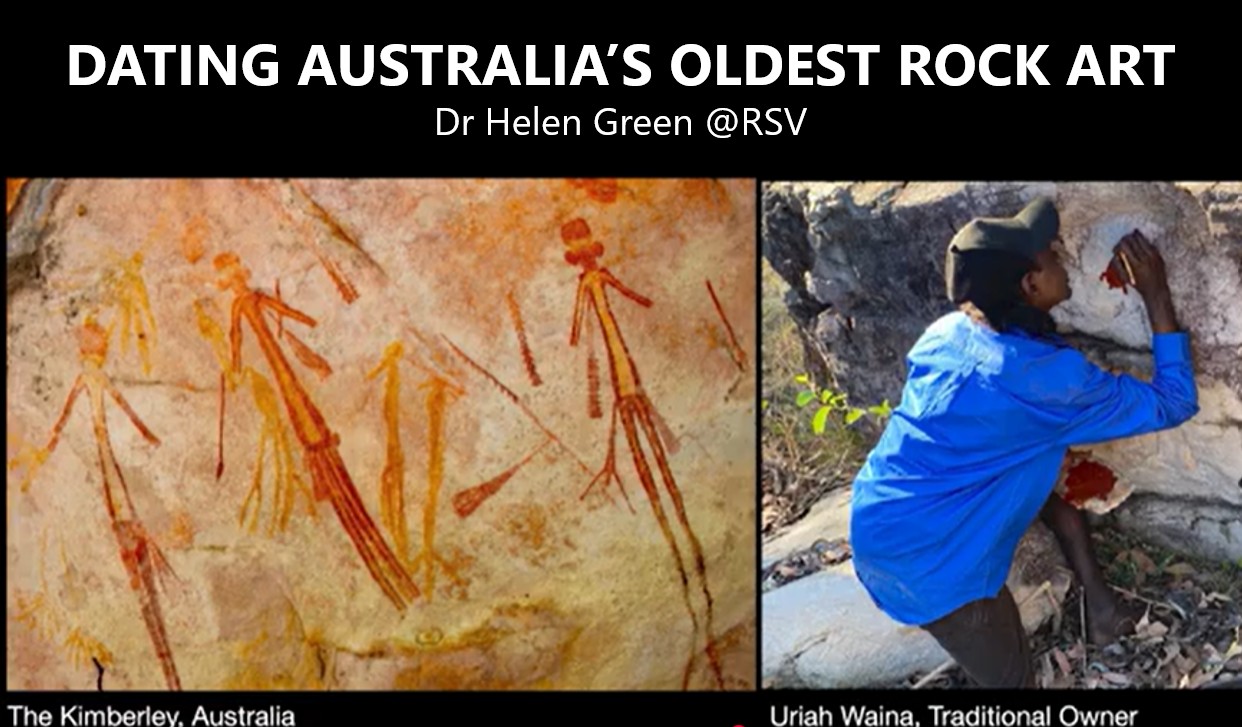
In June 2026 I was invited to give the annual Howitt Lecture at the Royal Society of Victoria on behalf of the Geological Society of Australia. You can watch the summary, the full lecture or read a bit more below
Highlights of my Howitt Lecture
My Full Lecture
Every year (excluding the lockdown years), our interdisciplinary team of geologists, archaeologists, geochemists, and Traditional Owners packs up our lives and travels to Barking Owl Camp—a remote base set along the Drysdale River on Balangara country in the far north of Western Australia. There’s no mobile reception (though Starlink has recently crashed that peaceful solitude!), we drink straight from the river, and our daily commute to work involves flying out in a tiny three-seater helicopter over a landscape nearly the size of Germany.
It is grueling, dusty, and deeply fulfilling work. But to understand why dating this art requires such an adventurous approach, you first have to understand the unique challenge the Kimberley presents.
The Kimberley Challenge: Why Dating Our Art Is Different
When people think of ancient rock art, they often picture underground caves in France, Spain, or Sulawesi in Indonesia. In those limestone landscapes, water moving through the rock deposits thin layers of calcium carbonate (speleothems) over the art, almost like a protective skin. Scientists can use uranium-series dating on those mineral crusts to find out when they formed, giving a clear minimum age for the painting underneath. Furthermore, many European cave drawings were made with charcoal, allowing direct radiocarbon dating.
In the Kimberley, nature dealt us a completely different hand:
Iron-Rich Ochre: The vast majority of Kimberley art was painted using natural mineral ochre (iron oxide). Ochre gives the paintings their vibrant red and orange hues, but because it is an inorganic mineral containing no carbon, trying to radiocarbon date ochre is like trying to date a handful of rust.
No Calcium Carbonate: The Kimberley's magnificent sandstone shelters are over 1.8 billion years old. Sandstone doesn't form calcium carbonate crusts, meaning the uranium-series techniques I trained on during my PhD simply didn't work here.
If we couldn't date the paint directly or use limestone crusts, we had to start looking at rock art associated materials—things built on top of or beneath the art.
The Breakthrough: Fossilized Mud Wasp Nests
Our major breakthrough came from an unexpected source: solitary mud wasps.
For thousands of years, these tiny insects have built their nests directly onto the walls and ceilings of sandstone rock shelters—sometimes directly over a painting, and sometimes right underneath one.
When a wasp constructs its nest, it scoops up local mud, which inevitably contains micro-particles of charcoal from ancient bushfires or cooking hearths. Over millennia, these nests fossilize.
By carefully extracting microscopic specks of charcoal from inside these fossilized nests, my colleague Dr. Damian Finch has pioneered the use of high-precision radiocarbon dating to bracket the age of the artwork sandwiched between them.
       [ Fossilized Mud Wasp Nest ]  <-- Dated via Radiocarbon (e.g., <= 17,200 years)
  =================================
        [  Ochre Rock Art Motif  ]  <-- Target Artwork
  =================================
       [ Underlying Wasp Nest ]    <-- Dated via Radiocarbon (e.g., >= 17,500 years)
Through this technique, we’ve achieved some astonishing milestones:
Australia’s Oldest In-Situ Painting: In a low, dark shelter just upriver from our camp, we dated wasp nests above and below a large painting of a kangaroo. The nest over the art returned an age of ~17,200 years, while the nest underneath was ~17,500 years old. This gives the kangaroo a median age of 17,300 years old, making it Australia’s oldest known intact, in-situ painted motif.
The Gwion Style Sequence: By dating hundreds of nests across the region, we’ve been able to statistically demonstrate that the famous, highly detailed Gwion figures proliferated across the Kimberley around 12,000 years ago.
Unlocking Climate History with Dark Glazes
While mud wasp nests have transformed our understanding of the rock art timeline, wasps didn't build everywhere. To fill in the gaps, our team is currently pioneering another method using the thin, dark glazes that form on sandstone surfaces over tens of thousands of years.
These glazes form through interactions between microorganisms, minerals, and moisture. Crucially, they contain calcium oxalate, a mineral that holds organic carbon.
When we look at cross-sections of these glazes under a microscope, we see intricate internal layers—almost like little geological barcodes—that match up across sites over 100 kilometers apart. Because their growth is driven by regional climate shifts, dating these glaze layers will not only help us date associated rock art and engravings, but will also allow us to reconstruct the exact environmental conditions the artists experienced thousands of years ago.
For instance, between the era of the 17,300-year-old kangaroo and the emergence of the Gwion human figures 12,000 years ago, sea levels in the Kimberley rose by 50 meters. As the ocean swallowed vast coastal plains, human populations were compressed into smaller areas. Understanding these environmental pressures gives us profound insights into why artistic styles evolved—transitioning from solitary naturalistic animals to complex human figures depicted in ceremonial dress and territorial markers.
More Than Numbers: A Living Cultural Connection
As a scientist, working out the age of a panel is thrilling. But what makes working in the Kimberley truly life-changing is that these are not forgotten archaeological ruins—they are living cultural places.
Unlike Europe, where the connection between modern populations and prehistoric cave artists was broken tens of thousands of years ago, Aboriginal people have cared for this country continuously for more than 60,000 years.
Every field season, site visit, and sample we take happens with the explicit permission, guidance, and active participation of Traditional Owners, such as the Balangara people and Kwini elders like Augustine Unhango.
I’ll never forget standing in a shelter with Augustine as he pointed to a tiny child's hand stencil on the wall and told us he had put his own hand there when he was just three years old. Moments like that remind you of the profound human continuity embodied in this landscape. Over the past decade, these working relationships with Traditional Owners have grown into deep personal friendships that have completely shifted my perspective on life.
Ultimately, our goal isn't just about chasing headlines or claiming the title of "world's oldest rock art." It's about working alongside Traditional Owners to honor the deep history of people on country, mapping how these extraordinary artistic traditions evolved, and connecting rigorous Western science with living cultural knowledge.
We are eleven years into this journey, but in many ways, we are just getting started.
For news and free access to our digital magazine on Science and Technology subscribe.rsv.org.au
Other articles of interest







Discover how you can join the society
Join The Royal Society of Victoria. From expert panels to unique events, we're your go-to for scientific engagement. Let's create something amazing.