The heat beneath our feet
Science Victoria Edition




.jpg)

Director, So Geothermal Pty Ltd
Most Victorians have no idea that the office buildings, shopping centres, and hospitals around them are quietly evaporating thousands of litres of drinking water every day. What a waste! Even more so, when you consider that a technology that eliminates this issue entirely, while heating and cooling buildings more efficiently than any conventional alternative, has been available for decades. And the AI boom has made the case for using it urgent.
The water hidden in plain sight
Look at the roof of almost any large commercial building in Australia and you will find one or more evaporative cooling towers. They are the chunky, fan-topped units that manage the heat from air conditioning systems, and they are so ubiquitous most people never give them a second thought.
They should. Each of these units evaporates treated drinking water continuously to shed heat into the atmosphere. For a typical office building, that process consumes tens of thousands of litres every week during the cooling season. For a large hospital or shopping centre running year-round, the annual consumption can reach millions of litres.
Cooling towers work on the same principle as perspiration: as water evaporates, it carries heat away with it. The physics is efficient, but the resource cost is real and largely invisible to the people inside the building. Water is consumed, discharged as blowdown to manage dissolved mineral concentrations, and supplemented continuously from the mains supply. None of it is recovered.
Under Victorian building regulations, cooling tower systems also carry significant compliance obligations – regular testing, water treatment programs, and risk management plans under AS/NZS 3666 to control Legionella bacteria – adding both to the cost and administrative burden of every building that runs one.
A single one-megawatt cooling-tower installation in Melbourne’s climate consumes about 3300 kilolitres of water a year. Multiply that across the hundreds of commercial buildings in any major Victorian city, and the aggregate demand on the water supply is substantial and almost entirely unacknowledged in planning and sustainability discussions.
Data centres: the cooling tower problem, magnified
Data centres bring this cooling tower problem into sharp relief. Unlike an office building, which needs heating in winter and cooling in summer, a data centre needs cooling continuously, year-round. Server racks generate intense, constant heat that must be removed regardless of the season outside. The cooling load is enormous and unrelenting, and almost all of it is currently shed through evaporative cooling towers that draw on the drinking water supply.
Australia’s data centre sector is growing at a pace that places this demand into a new category of concern. Capacity is projected to more than double between 2024 and 2030, from 1350 megawatts to about 3100 megawatts, driven by hyperscale investment from Amazon, Microsoft, and Google to support artificial intelligence infrastructure.
In Melbourne’s western growth corridor, Greater Western Water is currently processing water licence applications from proposed data centres representing up to 20 billion litres a year, equivalent to the annual water consumption of 330,000 Melburnians. In Sydney, the water authority has advised its pricing regulator that data centres in that city alone could demand 250 million litres every day by 2035, equal to Canberra’s entire daily supply.
Globally, AI data centre water consumption is projected to reach between 4.2 and 6.6 billion cubic metres annually by 2027. That is water drawn from municipal supplies, evaporated permanently, and replaced. The scale is new; the mechanism is the same rooftop cooling tower that has been sitting on commercial buildings for decades, simply replicated at a far greater intensity.
Ground source heat pumps: cooling and heating without water
Ground Source Heat Pump (GSHP) technology, also known as geo-exchange, uses the stable temperature of the ground to exchange heat, rather than evaporating water into the atmosphere. A closed loop of high-density polyethylene (HDPE) pipe, buried in boreholes drilled to between 100 and 200 metres deep, circulates fluid that transfers heat between the building and the surrounding geology. In summer, heat is rejected into the ground. In winter, warmth is extracted from it. The loop is sealed. Nothing evaporates; nothing is consumed; no noise is generated; and no water authority licence or Legionella management plan is required.
The closed-loop system uses no water whatsoever. The same sealed fluid circulates indefinitely through the ground loop, there is no evaporation, no discharge, and no connection to the water supply.
For data centres, which generate heat continuously year-round, closed-loop borehole systems are already proven at scale. Epic Systems Corporation in Wisconsin, a major technology company cools its data centre around the clock using one of the largest closed-loop geothermal systems in the world, with boreholes reaching 150 metres underground. Many other data centres in the US, including facilities in Iowa City and Nebraska, operate on the same principle.
Where engineers want to maximise long-term ground temperature stability, a small air-cooled dry cooler can supplement the borehole field — operating at night or in cooler months to discharge any accumulated heat using ambient air alone. No water. No evaporation. Peer-reviewed research by Cornell University and Verizon demonstrated this hybrid approach at a telecommunications data centre, and it cooled very efficiently.
Connecting to the ground: the options
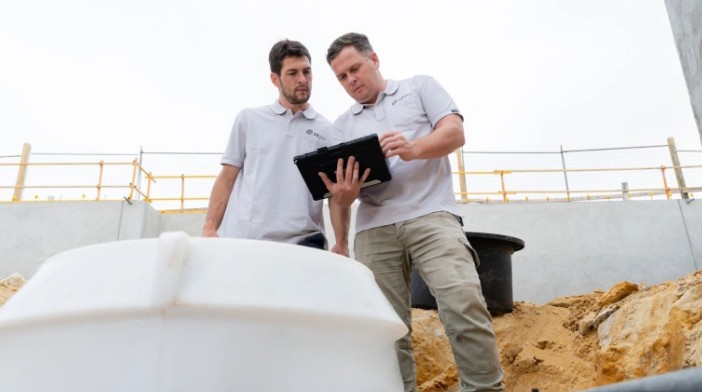
Vertical boreholes are the standard configuration for urban and commercial sites. Holes drilled to between 100 and 200 metres deep can accept a U-shaped HDPE loop permanently bonded to the surrounding rock or soil with grout that conducts heat. The surface footprint is minimal. A residential installation typically requires two to four boreholes, each leaving a mark no larger than a dinner plate. A commercial borehole field can sit under a car park, a school oval, or a building basement with no permanent surface infrastructure and no ongoing maintenance requirement.
Where land is available, horizontal trenches at one to two metres depth offer a lower-cost alternative. Properties with dams or lakes can use submerged coils. These are often the most thermally efficient option and require no drilling at all. For large commercial sites with access to a suitable aquifer, Aquifer Thermal Energy Storage (ATES) can store warm water underground during summer and recover it for winter heating. This technology is in routine commercial use across northern Europe. It re-injects the water back into the aquifer after extracting its thermal energy.
Efficiency: why GSHP outperforms every alternative
The performance of a heating or cooling system is measured by its Seasonal Coefficient of Performance (SCOP): the ratio of useful energy delivered to electrical energy consumed across a full year. A condensing gas boiler achieves a SCOP of approximately 0.9. A modern air source heat pump in Melbourne reaches around 2.5. A well-designed GSHP system in Victoria typically achieves a SCOP of 5 to 7.
Victoria’s conditions are particularly favourable. The ground across the state sits at 14–17°C year-round, giving the heat pump a low-temperature differential to work across and reducing the compressor load substantially. When paired with low-temperature underfloor heating running at between 35°C and 40°C rather than the 70°C required by conventional radiators, efficiency increases further still. During Melbourne’s mild shoulder seasons, the ground is often cool enough to provide passive cooling without running the compressor at all. This is what engineers call free cooling, at effectively zero energy cost.
For a data centre, that efficiency improvement translates directly into reduced operating cost. Cooling typically accounts for 30% to 40% of a data centre’s total electricity consumption. A system operating at SCOP 5 to 7 does not simply save water, it substantially reduces the electricity bill that comes with removing heat at industrial scale.
Already working at scale
The concept of ground-coupled building cooling is not theoretical. A large data centre in Luleå, Sweden, captures waste heat from its servers and directs it through ground-coupled systems into the municipal district heating network, supplying thermal energy to thousands of homes through winter. What was a disposal problem has become a community energy asset, with zero process water consumed in the process.
Closer to home, geo-exchange systems are already operating across Australian residential, commercial, and institutional buildings, and international experience shows the technology scales directly to data centre applications. Victoria’s geology – the basalt plains west of Melbourne and the sedimentary basins to the north – offers strong thermal conductivity for borehole installations.
Melbourne’s mild climate is particularly favourable: cool nights and mild winters mean that even where a dry cooler supplement is used, the system can operate efficiently using ambient air alone for much of the year, maintaining ground temperature stability at minimal additional energy cost and with zero water use.
For larger precincts, the US Department of Energy is actively funding commercialisation of Cold Underground Thermal Energy Storage, closed borehole fields beneath data centres that store coolth underground and release it during peak demand. The research projects Gigawatt hour-scale energy savings and strong financial returns, .
A broader role in Victoria’s energy transition
The case for geo-exchange goes well beyond data centres. Victoria’s energy transition has largely been framed around electricity generation, solar, wind, and storage. But a significant share of the state’s greenhouse gas emissions comes from burning gas directly in buildings for space heating and hot water. Decarbonising the electricity grid cannot address that combustion directly. Every gas furnace still in service continues to emit regardless of the energy mix on the grid.
GSHP systems powered by renewable electricity produce no direct emissions, consume no water, and provide both heating and cooling from a single installation with a service life exceeding 50 years. The technology is not new, it has been in routine commercial use in Europe and North America for four decades.
The combination of declining renewable electricity costs, Victoria’s gas substitution policy framework, and the growing urgency of the data centre water problem is creating conditions in which geo-exchange is more economically and environmentally compelling than it has ever been. The ground beneath Victoria has been at the right temperature all along.
““Every large building in Australia with a rooftop cooling tower is evaporating drinking water continuously. A ground source heat pump eliminates that entirely, and delivers heating and cooling at five to seven times the efficiency of a gas boiler.””.
Want to stay up to date and get articles like this and the latest Science Victoria digital magazine delivered straight to your inbox?
Subscribe for free now at subscribe.rsv.org.au
Other articles of interest






Discover how you can join the society
Join The Royal Society of Victoria. From expert panels to unique events, we're your go-to for scientific engagement. Let's create something amazing.