Breakthrough Victoria - Funding the leap from Lab to Life
Science Victoria Edition





BREAKTHROUGH VICTORIA - Victoria's private investment company
Why good research gets stuck in universities
A wearable drug delivery device that is electronically controlled to give a precise dose at the right time; software that dramatically cuts the time it takes to generate new alloys with specific properties; a blood test for early detection, and treatment, of neurodegenerative diseases such as Alzheimer’s.
Every year, Victoria’s universities generate extraordinary research and ideas. Many of them will be published in research papers, but only few will become businesses that transform our lives.
The reason is not a lack of talent or imagination; it is a gap in the system - early risk capital. Bridging that gap is the focus of Breakthrough Victoria’s University Innovation Platform (BVUIP). It’s a program designed to invest in early-stage companies that build businesses based on research from Victorian universities.
Breakthrough Victoria (BV) was established by the Victorian Government in 2021 as a private company. It invests in the commercialisation of intellectual property and research, backing bold founders and visionary fund managers to help transform the Victorian economy. Its University Innovation Platform (BVUIP) was created to tackle the university innovation problem directly, by focusing on the earliest and riskiest stage of establishing a scitech business – that period after an idea has shown real promise, but before a startup is ready for venture capital.
A partnership model, not a one-size-fits-all fund
The BVUIP has budgeted up to $100 million to co-invest with Victorian universities in partnerships designed to fit each university’s research strengths, culture and maturity.
Seven universities have now joined the platform. They have been backed by $59 million from BV and have made matching commitments. This has provided nearly $119 million in pre‑seed funding for entrepreneurs seeking to turn research into new companies. The universities involved and their commitments are:
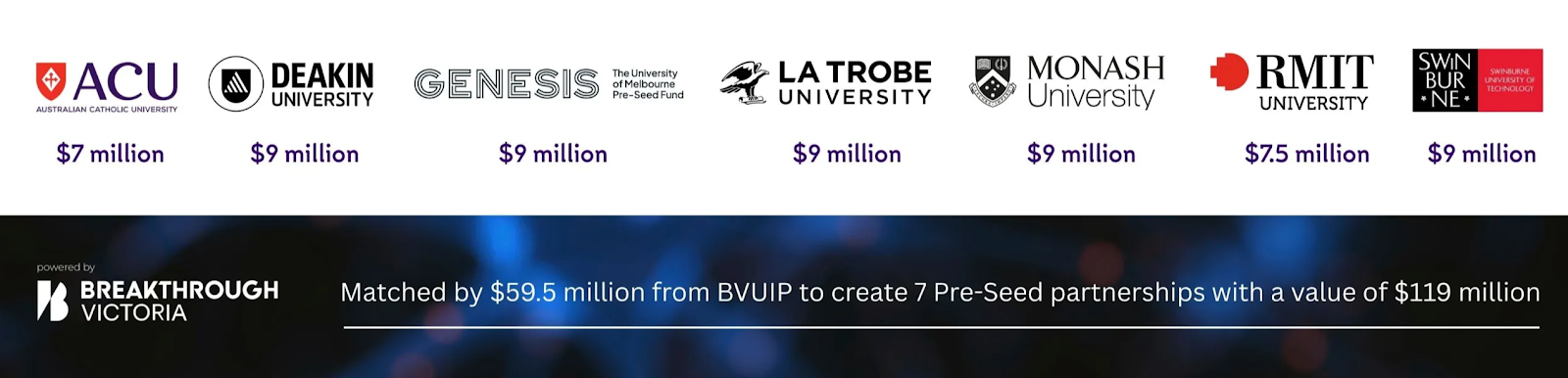
Since BVUIP’s launch in 2023, university pre-seed funds investment committees have backed 39 startups and social impact ventures, allowing them to test, refine and scale their ideas to turn their research into companies and social enterprises ready for investment.
EntroMat: AI for advanced manufacturing
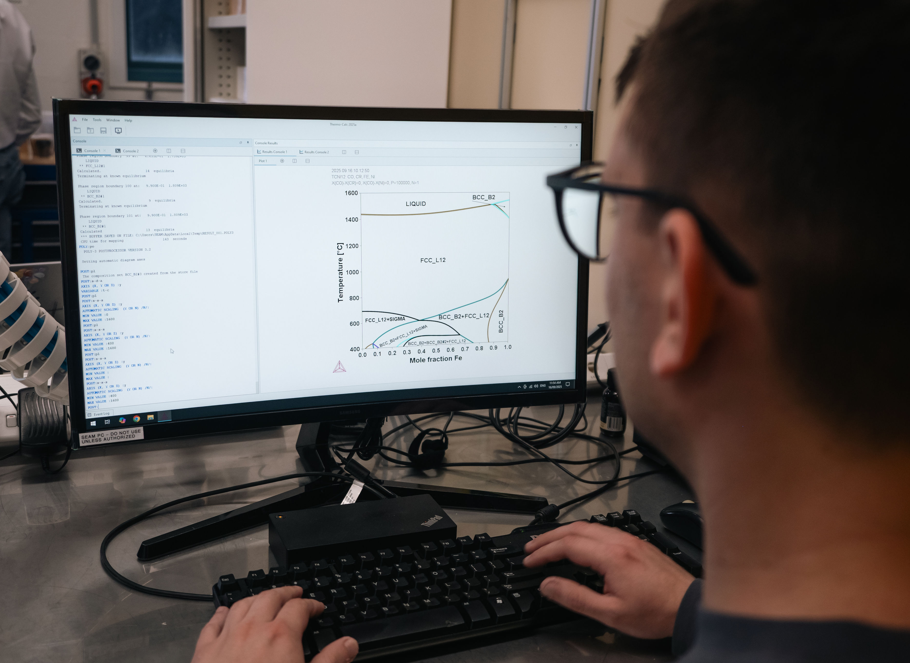
One of the first companies to benefit from the BVUIP approach was EntroMat at Swinburne University of Technology, which is developing an AI-enabled platform that can generate an infinite number of “recipes” for new alloys.
EntroMat’s platform produces materials with desired properties, such as corrosion-resistance, strength and durability, while drastically cutting development timelines from years to weeks. Critically, the platform enhances the security of company supply chains because it reduces reliance on using scarce rare-earth elements and those from geopolitically vulnerable sources. This allows manufacturers to localise production and scale resiliently at a time of disrupted global trade.
Based on more than 20 years of university research, EntroMat has built technology which can use Swinburne University’s manufacturing facilities. This allows the company to design new materials and make small test batches. Customers can then test the performance of these materials not just in the lab, but under real-world conditions.
Its capabilities put EntroMat in good company globally. Similar players include Lila Sciences (from the Massachusetts Institute of Technology (MIT) ecosystem in the US) and Cusp.AI (based in Cambridge, UK). Like them, EntroMat uses computing and data to design materials faster, then tests them quickly. But it has an extra advantage of being able to pilot batches locally, so customers can adopt the materials sooner.
Through the BVUIP, Breakthrough Victoria and Swinburne University have each invested $500,000 in EntroMat, giving it the early funding and support it needs to start scaling up. Even though EntroMat is about the same age as Cusp.AI and Lila Sciences (between two and three years), it has already demonstrated superior performance in two real-world pilot projects with manufacturers. That progress has been made with just AU$1 million of funding, while Cusp.AI has raised over US$130 million and Lila Sciences has raised about US$550 million. So EntroMat, like many Australian science-based startups that face tight access to capital, has delivered strong progress with comparatively modest investment funding.
Excelligent: Diagnosing disease earlier
Researchers working to solve a very different problem at La Trobe University faced the same funding gap.
Excelligent is a biotechnology startup developing a blood test for very early detection of neurodegenerative diseases such as Alzheimer’s.
There are now two medications that can slow the progress of Alzheimer’s for some. But these treatments work best when the disease is caught early, so effective early testing matters more than ever.
At present, Alzheimer’s is typically only investigated after someone (or their family) notices they have memory or thinking problems. A doctor might start with memory but, to confirm an Alzheimer’s diagnosis, further tests are required. To date, this has often meant a brain scan or a lumbar puncture, a needle inserted into the lower back to test the fluid around the spinal cord. These tests are invasive, expensive, and not easy to access, so they are typically only used by specialists once there is strong reason to suspect dementia or unusual early symptoms.
Excelligent’s goal is to make early screening simpler and less invasive. The technology aims to detect Alzheimer’s about three years before noticeable cognitive decline, giving people time to act sooner. That early warning can help people and families make practical changes and plans.
But bringing medical diagnostic tools to market involves regulatory hurdles, validation studies and long development timelines - all difficult to fund for a startup. Through La Trobe’s Eagle Fund, a pre-seed partnership established under the BVUIP, Excelligent received a $1 million investment, co-funded by Breakthrough Victoria and the university, to continue its development.

Remagine Labs: Making treatment easier
Millions of people live with long-term health conditions such as epilepsy and Parkinson’s disease. Getting the right diagnosis early matters. (That’s why predictive early diagnostics companies like Excelligent are important.) But after diagnosis, there is another big issue: taking medicine correctly, every day, for years.
For many people, taking medication at the correct time - sometimes several times a day – is challenging. If a dose is missed, taken late, or in the wrong amount, severe symptoms, such as seizures, can return and the consequences can be serious.
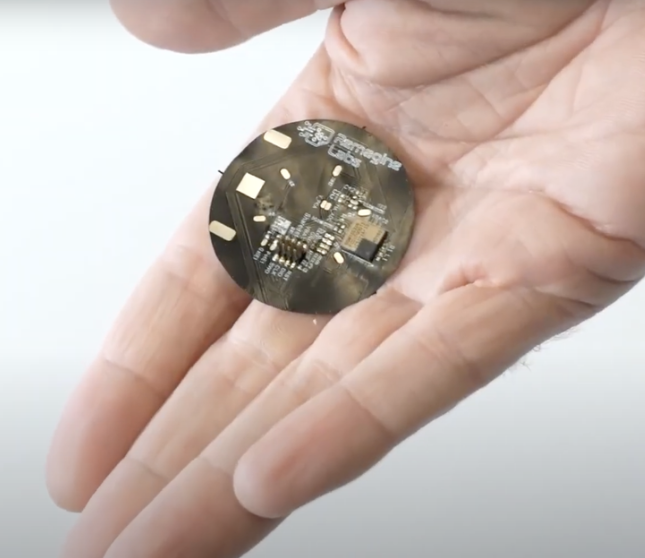
This is the problem Remagine Labs is working to solve. Reimagine Labs, a University of Melbourne spin-out that is partnered with Monash University, is developing wearable, electronically controlled, drug delivery devices.
The goal is simple: to make it easier to stay on track. A wearable device can deliver doses automatically, reducing missed or late doses and keeping treatment more stable.
But building a safe medical device that can be manufactured properly takes early funding, specialist facilities and interdisciplinary expertise. Through the Monash Ventures Pre-Seed Fund and the University of Melbourne’s Genesis Pre-Seed Fund, both supported by the BVUIP, Remagine Labs received $1 million of investment capital.
The funding has helped the team to move beyond early proof-of-concept, build working prototypes and prepare for the next important clinical and commercial milestones. It has also attracted global talent to Victoria in the likes of technology entrepreneur Pat Kelly, who founded Remagine Labs with University of Melbourne Professor Stan Skafidas. As CEO, Kelly brings strong links to the US semiconductor and startup community.
Building a system, not just startups
While these companies operate in very different fields they share a common story. Each sits at the intersection of strong research and real-world need. Each faced a funding gap that could have stopped their progress. And each benefited from a partnership designed to bridge that gap.
The BVUIP also includes a Breakthrough Fellowship Program, a $7.5 million initiative that invests in ventures started by recent graduates. Many PhD students spend three or more years doing the research - the “R” in R&D - but there is often no clear pathway to do the “D” (development) work, turning what they have discovered into something that works in the real world. As a result, much of their research effort ends up captured only in journal papers and a thesis. The Fellowship program was created to bridge this gap.
In 2025, BV invested $150,000 in the first three Fellowships. They went to startups led by recent PhD graduates – Michelle Chen from RMIT University for Mental Jam, computer games that explore mental health conditions; Noor Karishma Shaik from the University of Melbourne for DeepDerm AI, cameras that detect skin cancer; and Mohammad Haft Tananian for Innova IVF, a medical device to evaluate embryo viability.

Why this matters for Victoria
Public investment at the pre-seed stage is not about replacing private capital. It is about unlocking it. By reducing early risk and improving commercial readiness, programs like the BVUIP make it easier for private investors, industry partners and global markets to engage down the line. The result is a multiplier effect, where public funds attract far greater levels of private investment.
Keeping these companies in Victoria means that the benefits of research - economic, social and technological - flow back to the community that created and supported them.
According to independent analysis by EY (previously Ernst & Young), Breakthrough Victoria’s investment in their broader portfolio is forecast to contribute $5.3 billion to the Victorian economy by 2035, through job creation, industry growth and new capabilities.
You can find out more about the BVUIP and its Fellowships here https://breakthroughvictoria.com/university-innovation-platform/. Fellowship applications are accepted until 7th April 2026, with the next cohort due to begin their fellowships in July 2026.
Want to stay up to date and get articles like this and the latest Science Victoria digital magazine delivered straight to your inbox?
Subscribe for free now at subscribe.rsv.org.au
Other articles of interest






Discover how you can join the society
Join The Royal Society of Victoria. From expert panels to unique events, we're your go-to for scientific engagement. Let's create something amazing.