Kapturing a Carbon Market
Science Victoria Edition





Editor, Science Victoria
Raj Bagri and her company Kapture are in the final stages of testing a product that can reduce the carbon dioxide output of a diesel generator by more than 90 per cent.
That may sound humdrum, until you recognise that there are more than 120 million diesel generators spread throughout industry and in the more remote parts of the world. And they pump out the equivalent in greenhouse gases of about 4000 coal-fired power stations.
In addition to reducing this load significantly, the carbon captured by Raj’s technology can be recycled either as a fertiliser or as a component of concrete, the production of which in itself involves huge emissions of greenhouse gas. Win-win.
Raj's journey

So how did Raj do it? She would argue that it is because she is neither a research scientist nor an engineer, but someone who set out to establish profitable businesses.
“I really think I’m a true entrepreneur. When I was working with engineers in a food tech start-up, I watched them building technology. That’s when I realised that engineers love the process of R&D, but not necessarily commercialisation or showing the world their inventions.”
Raj comes at things the other way around, not inventing a product in the hope that industry can use it, but specifying what industry needs and going out to find an invention to fit.
“In 2020, the news headlines about carbon capture were that it wasn’t working. Typically, it was expensive, energy intensive, inflexible, and there were issues with storing the carbon once you’d captured it. I thought, ‘What if we develop a technology which is low-cost, highly scalable, and we can recycle the CO2 back into the circular economy.’ That’s what I set out to do.”
A new take on well-known Chemistry
What Raj found was a chemical reaction which has long been used to trap CO2, but Kapture has employed it in a novel way. The exhaust from a diesel generator is fed through a solvent with which it reacts to form a carbonate by-product that permanently locks in the carbon. This by-product can then be used to replace aggregate in concrete or as a lime-based fertiliser buried in the soil, enriching carbon levels.
The initial application of Kapture’s technology will be to stationary generators. The technology can be retrofitted to a generator of any size with little or no interruption to company activity. Not only does it take minimal time – less than an hour, Raj says – but it does not impair the functioning of the generator in any way. And when the solvent becomes depleted, it is simply replaced and the resulting by-product removed and recycled.
But stationary generators may just be a start. “We are in discussions with a mining equipment company in WA, and they’re very interested in looking at fitting it to dump trucks. Mobile, however, is a lot more complex."
“The technology also reduces emissions of nitrogen oxides (NOx), sulphur oxides (SOx) and particulate matter. And compared to any other system, the energy use is relatively low.”
From Proof of Concept to Scale
In the past year, the company has successfully tested its technology with PERMAcast, a WA pre-cast concrete company which can use the by-product in its operations, and also with Horizon Power, a WA regional energy company.
“Using Kapture technology, companies get immediate decarbonisation.” That will help them meet any current or future regulatory standards. “And with our technology, customers don’t have to replace their diesel fleet. It doesn’t disrupt their operations. They don’t have to bring toxic chemicals on site. In fact, they don’t have to change their behaviour in any way.”
The main competitors, Raj says, are other carbon capture utilisation and storage startups, battery systems, and biofuels. But biofuels are expensive at present, Raj says, and the generator manufacturers say they are not able to be used in current equipment. “So we are keeping diesel generators alive!”
Lean Start-Up Today, The World Tomorrow
As a lean, mean start-up, Kapture at present employs only three people full-time, Raj and two engineers – Sanjay Sanil, an automation engineer and Sai Vamsi Tirumalasetti, a process engineer who is optimising the chemical reactions. All the administrative, financial and other functions are outsourced.
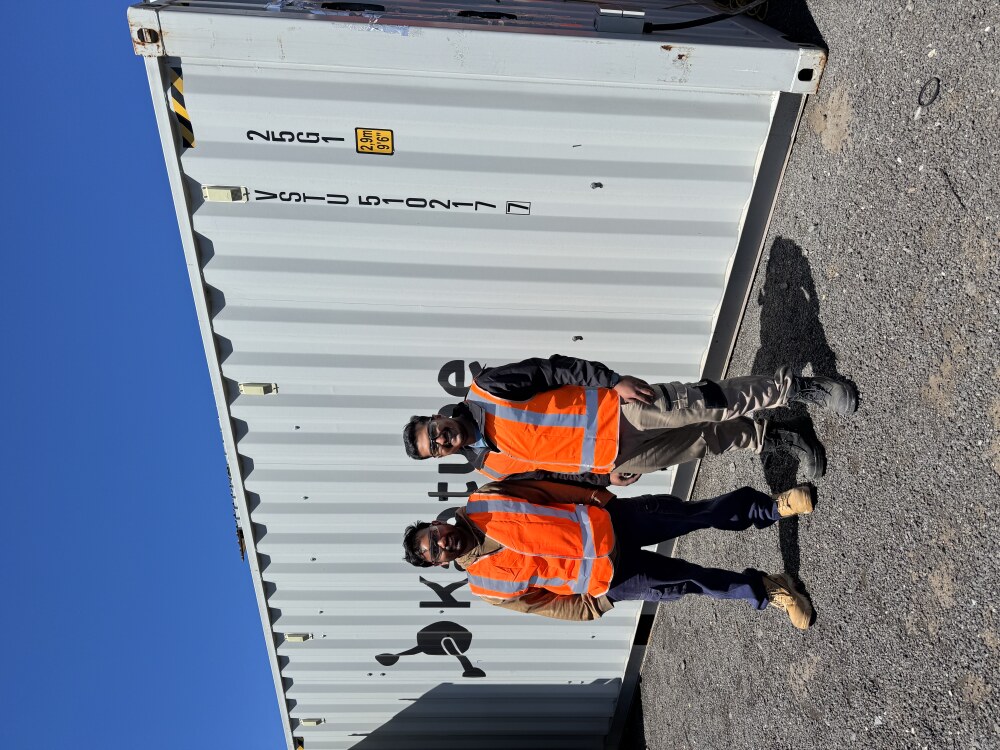
But within the next year or so, Raj hopes all that will change. Final field testing of their product has been set for early 2026. If all goes well, the technology will be commercialised soon afterwards. “We will raise funds from strategic partners, and they will help us scale up globally.”
In fact, Kapture has had no Government assistance all through its development process. “The way the start-up ecosystem works in Australia is that if you’re not from a university or don’t have a PhD, you are not likely to be supported by Government or venture capitalists.”
In hindsight, that hasn’t been a bad thing for Kapture. “We have relied on, and are very grateful for, “angel” investors that have believed in our mission from day one, in particular, the Startmate Accelerator, a program that brings people with ideas together with investors and knowledge".
“It really takes a village to build a company. And we now have a huge network of support through our angel investors.”
In fact, one investor, John Wood, changed the whole trajectory of what Kapture was doing.
“My initial idea was to fit the technology onto the chimneys of houses. It was John who said to me, “Why don’t you look at diesel generators?”
Want to stay up to date and get articles like this and the latest Science Victoria digital magazine delivered straight to your inbox?
Subscribe for free now at subscribe.rsv.org.au
Other articles of interest








Discover how you can join the society
Join The Royal Society of Victoria. From expert panels to unique events, we're your go-to for scientific engagement. Let's create something amazing.