From Atoms to Products - engineering tomorrow’s high-performance materials
Science Victoria Edition

CEO and co-founder, EntroMat Pty Ltd

Behind almost every transformative technology lies a breakthrough in materials that makes it possible.
The shift to clean energy, for instance, requires stronger, lighter and more heat-resistant components. Advanced manufacturing needs metal powders that can be printed, pressed or sprayed to build reliable products. Mining, steelmaking and heavy industry need equipment that survives for longer than usual under conditions of wear, corrosion and extreme temperatures. Defence, aerospace and energy systems demand materials that continue to perform past where conventional alloys reach their limits.
Many of the alloys used today were developed decades ago. They have served industry well, but operating conditions and expectations are changing quickly. Manufacturers are increasingly requiring materials that can withstand harsher environments, last for longer and meet tighter environmental requirements, while remaining practical and economical to produce at scale.
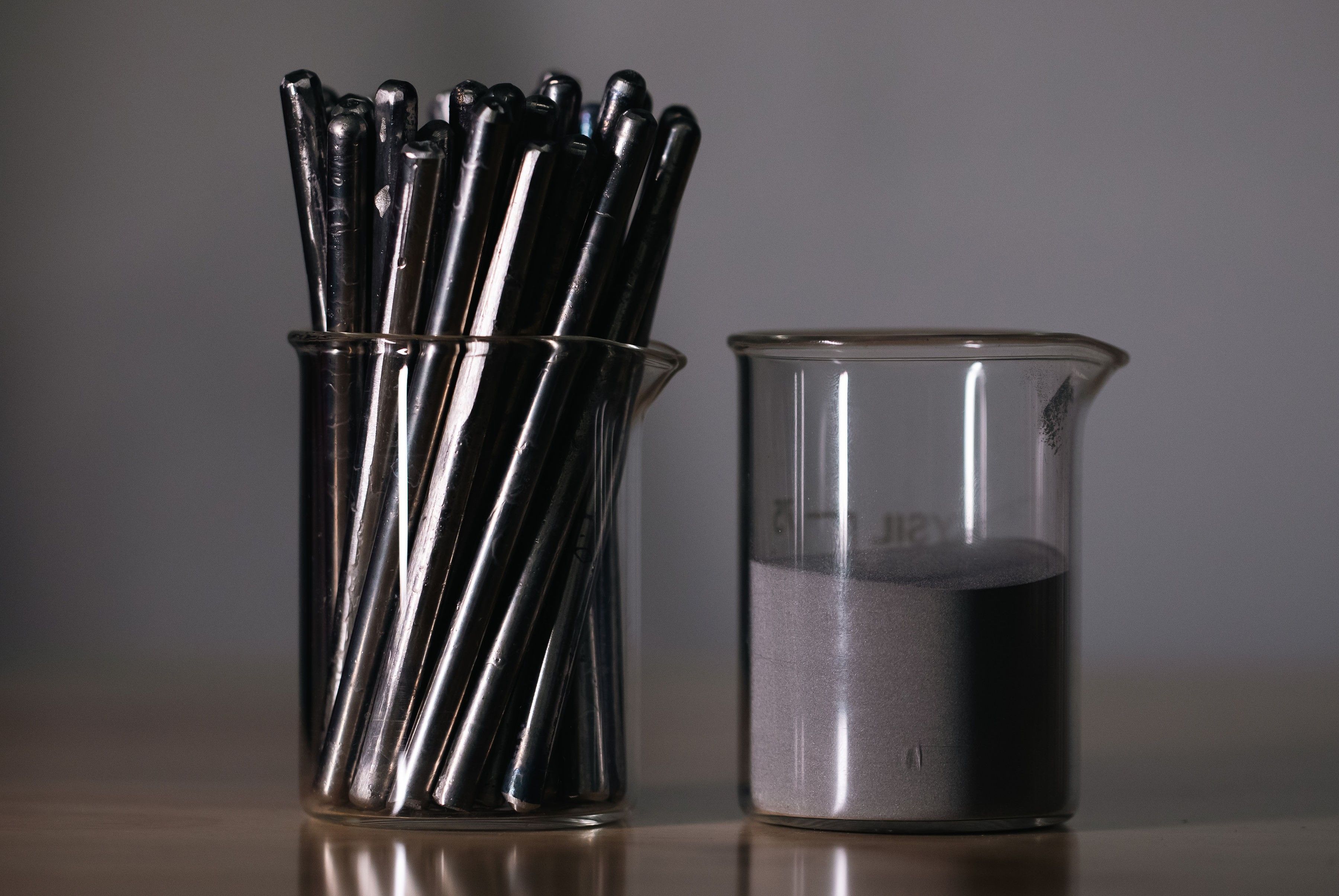
EntroMat is pioneering a novel approach to developing new alloys. By combining artificial intelligence, thermodynamic modelling, and advanced materials science, the company can rapidly identify and test promising alloy compositions that deliver unique combinations of properties, such as wear resistance, corrosion resistance, toughness, and thermal stability. This data-driven development process is also focused on sustainability, for instance, reusing high-value industrial alloy feedstocks to create next-generation materials, thus reducing reliance on virgin critical minerals. The result is a faster, more efficient pathway to developing high-performance materials tailored to solve real-world industrial challenges.
A new way to design metals
Most familiar alloys are built around one dominant element. Steel is mainly iron, while many aerospace superalloys are based on nickel. Smaller additions of other elements are used to adjust properties such as strength, corrosion resistance or high-temperature stability.
But EntroMat is working on an emerging class of materials broadly known as high-entropy materials (HEMs). Rather than relying on a single dominant element, these alloys contain substantial proportions of several principal elements. They are often described as containing five or more major elements in equal or near-equal ratios. This wider freedom of composition can produce useful combinations of phases and properties that are difficult to find in conventional alloys.
A material can be engineered, for instance, to balance hardness with toughness or wear resistance with corrosion resistance and thermal stability. Achieving that balance is essential: a very hard material may resist abrasion but crack under impact, while a highly corrosion-resistant alloy may be too soft for severe wear. The best composition depends on the components, the manufacturing process and the operating environment.
But if you are considering many elements and concentration ranges, the number of possible compositions of an alloy becomes far too large to investigate each one individually and efficiently by trial and error.
Using AI to narrow the search
So EntroMat is using AI-guided design alongside thermodynamic modelling to identify the promising alloy families quicker. The thermodynamic calculations predict which phases are likely to form as an alloy solidifies or experiences different temperatures. And data-driven tools can relate the composition and processing conditions to the properties you want to target.
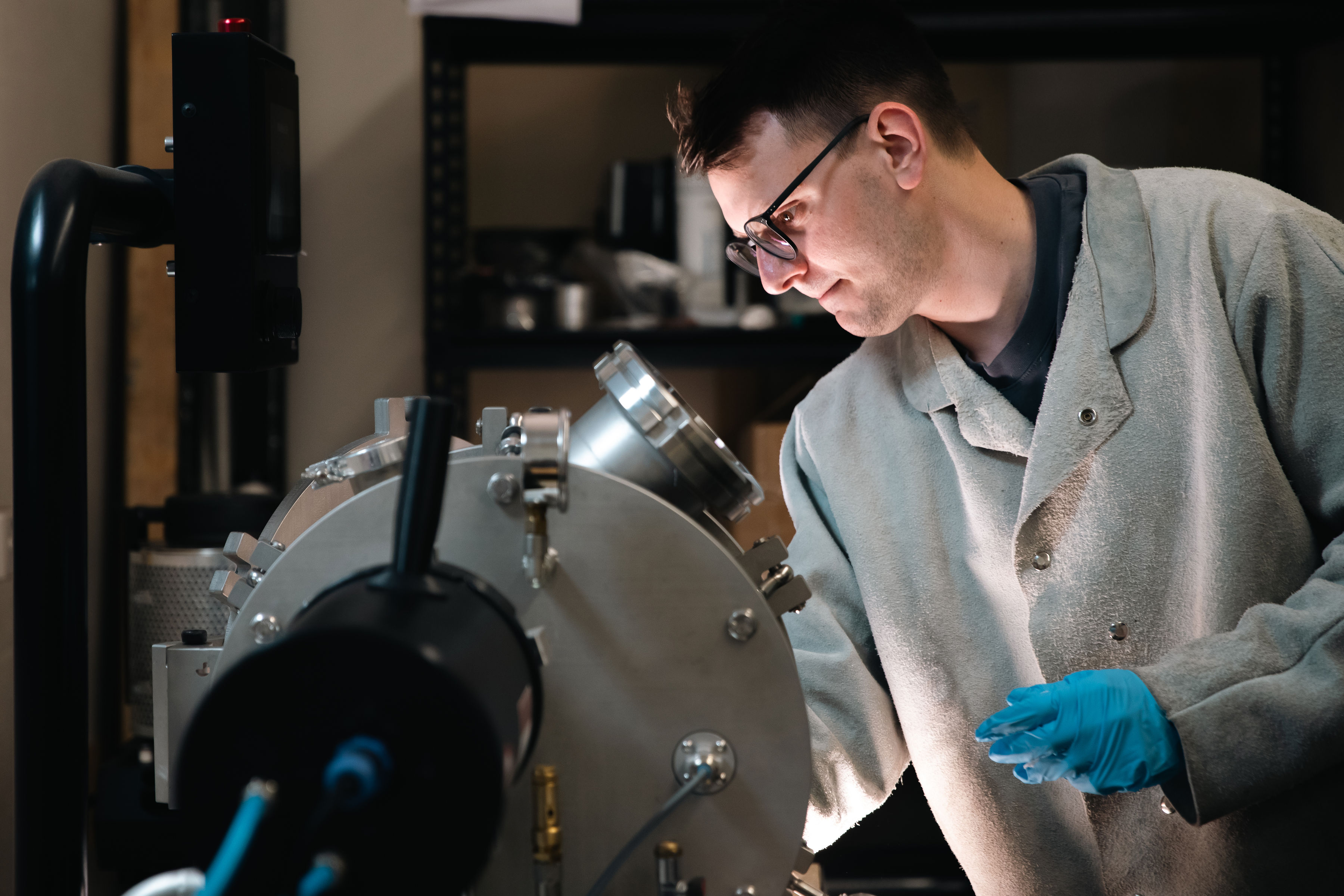
AI does not replace materials scientists or physical testing. It simply helps us ask better questions and focus laboratory work on the most credible candidates. Shortlisted alloys still need to be produced, their phases and microstructures defined, and their mechanical, wear, corrosion and processing behaviour tested.
This creates a closed loop of development: AI screening guides experiments; experimental results improve the models; and industrial requirements determine what is tested next. The goal is not simply to discover an unusual composition, but to develop a material that can be manufactured consistently and solve a defined problem.
The pathway to market
EntroMat’s initial product focus is on advanced industrial coatings. These relatively thin engineered layers, applied by processes such as thermal spraying or laser deposition, can protect expensive components from wear, corrosion, heat or chemical attack. Extending the life of these surfaces can keep machines operating for longer, reducing replacement, maintenance and downtime.
In steelmaking, mining, energy and heavy industries, coating failures can cause production losses, scrap and safety risks. These are not abstract scientific challenges; they are costly operational problems that customers recognise.
We are developing coating materials for harsh conditions, including for situations in which established solutions, such as hard chromium plating, tungsten carbide-based coatings or ceramics, may face particular performance, cost, processing or environmental constraints. The objective is not to claim that one material can replace every conventional coating, it is to design the right material system for a clearly defined combination of conditions – wear, corrosion, temperature and manufacturability.
Beyond coatings: Metal powders for 3D printing
The same approach can be applied to designing powders for additive manufacturing, commonly known as metal 3D printing. In these processes, components are built layer by layer. This allows for the development of complex shapes It also can lead to reduced material waste, consolidation of parts and specialised production closer to the point of use.
At present, additive manufacturing is constrained by the limited range available of qualified powders. Many powders used today originated as conventional casting or wrought alloys and were later adapted for 3D printing. There is a major opportunity to design alloy composition, solidification behaviour and powder characteristics together, so the feedstock is suited both to the printing process and to the required performance of the finished product.
Powder metallurgy: A major established market
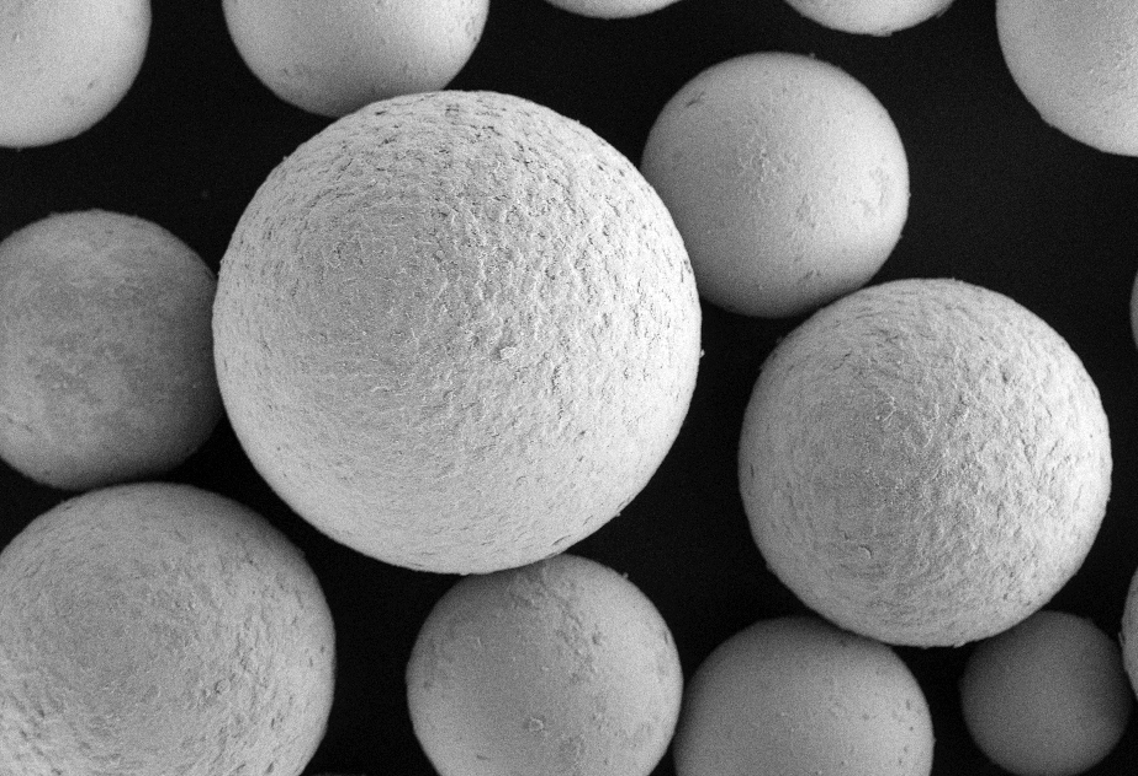
Another pathway is powder metallurgy, in which metal powders are compacted and heated to form solid parts. This process can be used to manufacture large numbers of components efficiently, with low material waste, and with structures or property combinations that may be difficult to achieve through casting and machining.
Although additive manufacturing receives more public attention, powder metallurgy is already deeply embedded in industry. It is used for automotive components, wear parts, cutting tools, filters, magnetic materials and many other engineered products. For EntroMat, it represents an opportunity to translate advanced alloy design into established, high-volume manufacturing.

Designing for circularity
Advanced materials must also respond to supply-chain and sustainability pressures. EntroMat is exploring recycling routes that can employ high-value industrial alloys as feedstocks, alongside conventional raw materials. Instead of treating valuable alloy content as waste, these streams can be used as building blocks for new high-performance compositions.
This approach is technically demanding because commodity alloys vary in chemistry and contain elements that must be controlled. Computational design, chemical analysis and rigorous processing are therefore essential. When applied appropriately, this approach can reduce reliance on virgin critical materials while creating higher value uses for existing alloys.
Why this matters for Victoria
Victoria has many of the ingredients needed to build advanced materials relevant to global companies – strong universities, manufacturing capability, skilled engineers, investors and access to demanding customers across mining, energy, defence and industrial production.
The opportunity is there, to turn scientific capability into products that travel. A material designed and developed in Melbourne could protect equipment in an Australian mine, extend the life of a steelmaking component in North America, or enable a manufacturing partner in Europe.
That is the promise of deep technology: local scientific expertise translated into solutions for global industrial problems. For EntroMat, the mission is larger than creating one better alloy. It is to build a faster, evidence-based and scalable way to develop the materials required by a modern industrial economy, from atoms to industry.
Want to hear more about innovative technology businesses in Victoria and Australia?
subscribe.rsv.org.au
Other articles of interest




Discover how you can join the society
Join The Royal Society of Victoria. From expert panels to unique events, we're your go-to for scientific engagement. Let's create something amazing.