The MOF Revolution: molecular sponges take on plastic waste
Science Victoria Edition
Research Fellow, Department of Materials Science and Engineering, Monash University
In the time it takes to read this article, you will probably breathe in or swallow a few specks of plastic. These tiny fragments, called microplastics and thousandths of a millimetre in diameter, are now turning up almost everywhere scientists look: in oceans and soil, in the food we eat, in human blood, and even in the placentas that nourish unborn babies [1] [2]. Plastic has truly become part of us all.
Our group at Monash University is developing ways of cleaning some of this up: fishing the plastic out of water and, better still, turning yesterday's plastic into tomorrow's. Victoria, as it happens, is a good place to be doing it.
Plastic recycling is not what most people think
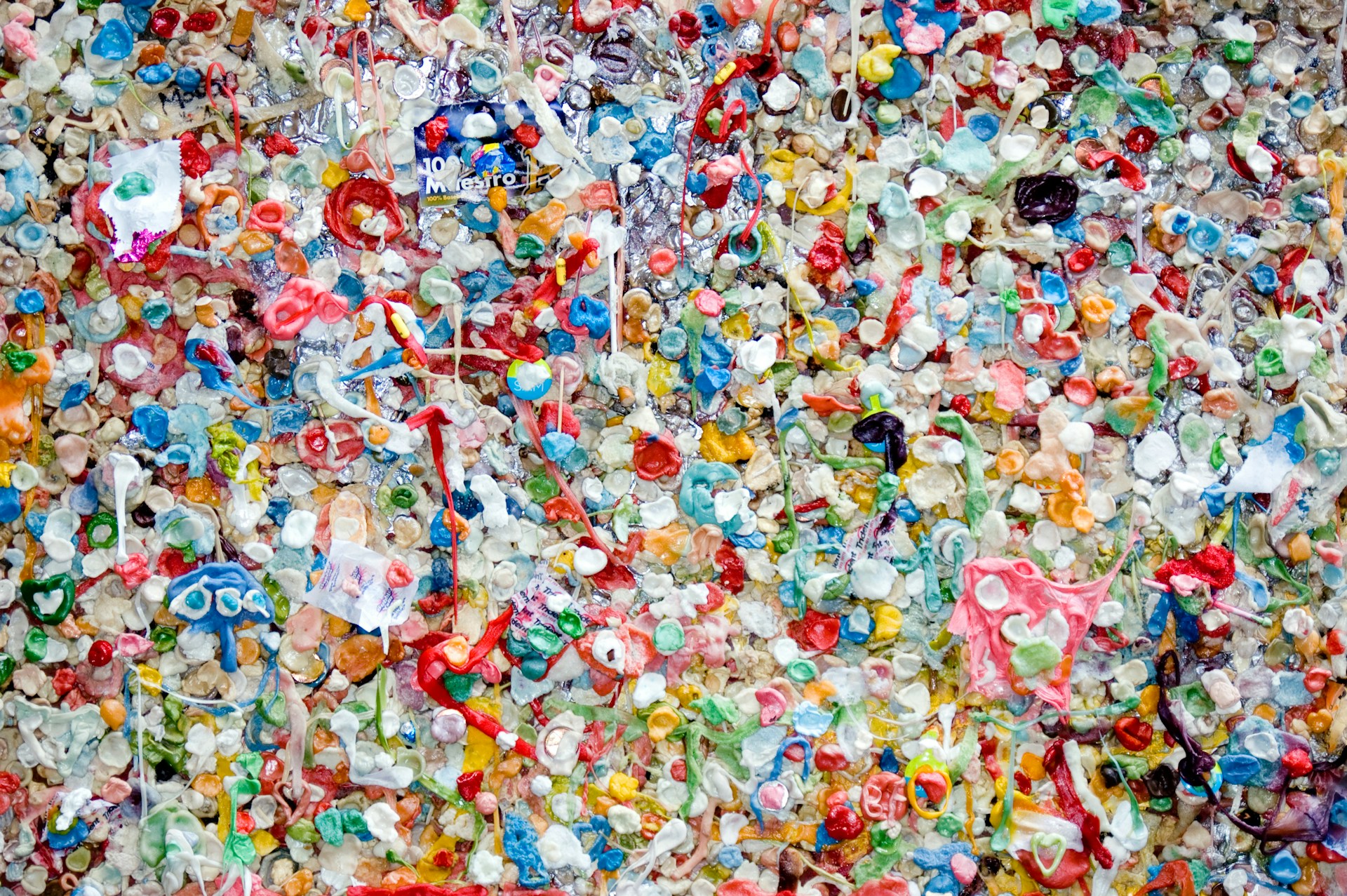
Only about 9% of all the plastic ever made has been recycled.[3] The rest is buried, burned, or lost in the environment, where it slowly crumbles into those microplastic particles we are breathing in and swallowing. And because plastic is made from carbon-based fossil fuels, this is a climate problem as much as a litter one.
Ordinary recycling, which melts bottles down and reshapes them, yields slightly poorer plastic each time, until it is fit only for the bin. Real recycling needs to go further – chemically unzipping a plastic back into the small molecules from which it was built, monomers, and then stitching them together into fresh, high-quality plastic.
Picture plastic as a long chain with each monomer a single link. The recycling trouble starts once the chain is broken. What you get is not a tidy pile of identical links but a molecular soup – single monomers, pairs of them still joined together (dimers), and longer bits of chain leftover, all swirling in water. Sorting out the pure monomers from this is one of the hardest, most energy-hungry steps in the whole process.
Molecular sponges with made-to-measure holes
But a new class of materials is unusually good at exactly this kind of sorting: metal-organic frameworks or MOFs. These are microscopic scaffolds built of metal “joints” and carbon-based “struts”. They form crystals riddled with orderly, identical holes, and astonishingly porous. The area of surface exposed inside a few grams of a MOF can rival the area of a football ground.
The useful thing is that MOFs can be tuned. By choosing different metals and organic struts, chemists can set the size and shape of the holes with almost atomic precision, so the crystal can let one molecule in and turn another away. In effect, the MOF becomes a molecular sieve. And sieving apart look-alike molecules, like monomers and dimers, is exactly what plastic recycling demands.
The whole field of MOFs grew out of an idea hatched at the University of Melbourne in the 1980s, when chemist Richard Robson reasoned that metal ions and organic linkers could assemble themselves into these vast, porous frameworks [4]. So Victoria helped start the whole field.
Un-mixing the plastic soup
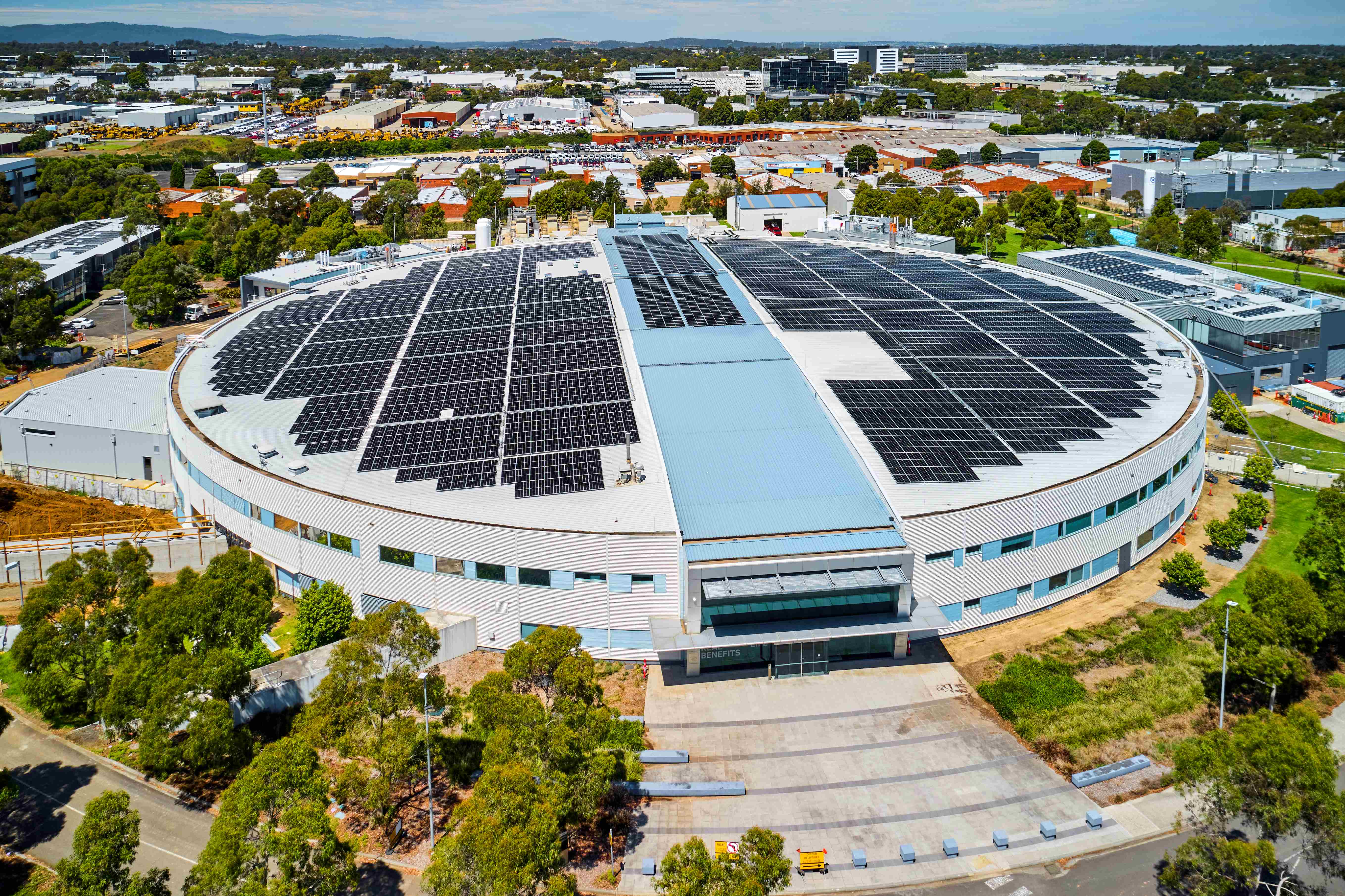
That work is still very much alive in labs across the State. And as part of CSIRO's Ending Plastic Waste Mission – a collaboration between Monash, CSIRO and the University of Texas at Austin – my colleagues and I build membranes from the ground up that do exactly this kind of molecular sorting.
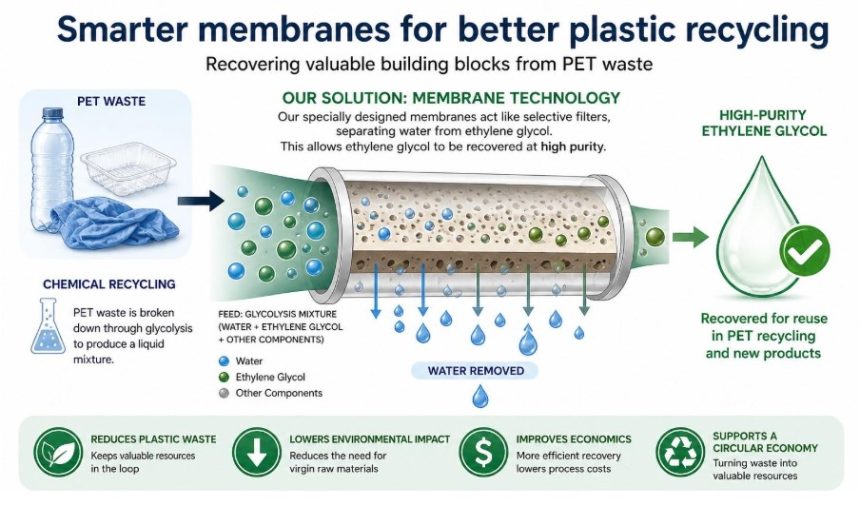
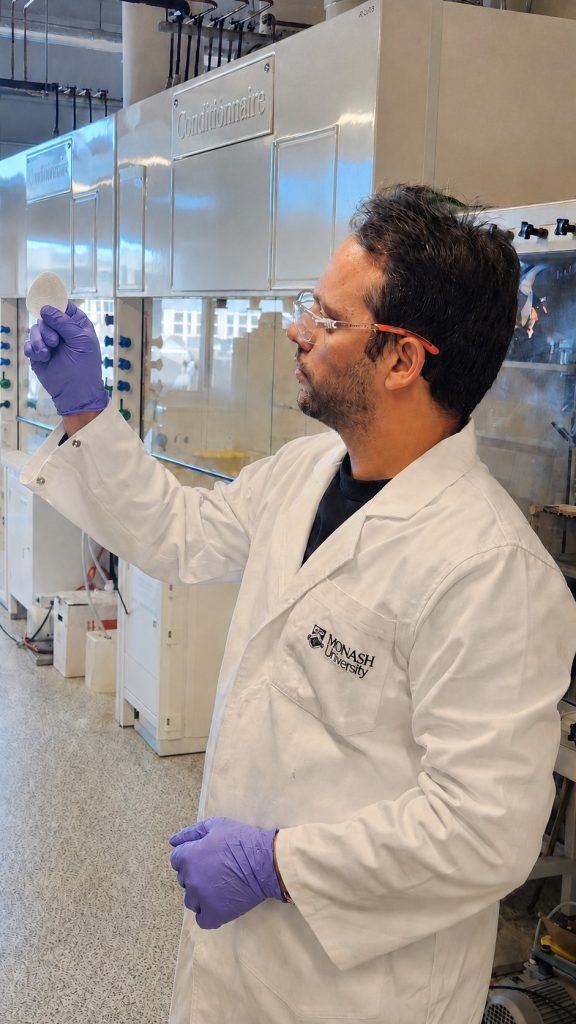
Our membranes are thin plastic films with MOFs and related porous crystals baked into them. We then fine-tune them, adjusting their chemistry to grip the molecule we want and let everything else pass by. A wafer-thin top layer does the sorting; a tougher, more open layer beneath provides strength. Alongside Professors Benny Freeman, Matthew Hill, and Zongli Xie, we test many recipes to find the ones that separate best.
The separation itself works by a method called pervaporation. The liquid breakdown mixture bathes one side of the membrane. On the other side is a vacuum, so whatever crosses through the membrane evaporates and is drawn off as vapour. Small water molecules slip through, for instance, while larger molecules are held back, so the membrane acts like a filter that gently boils off just the part you want gone.
Here is where our approach differs from most. Published membranes tend to run at high temperature – 60 to 80 °C – and that demands energy. Ours are designed to do the job at room temperature and to keep working even when there is a great deal of water to remove, a situation much closer to actual working conditions. Achieving the same result without expending heat energy is exactly the kind of saving that decides whether a recycling process is worth scaling up.
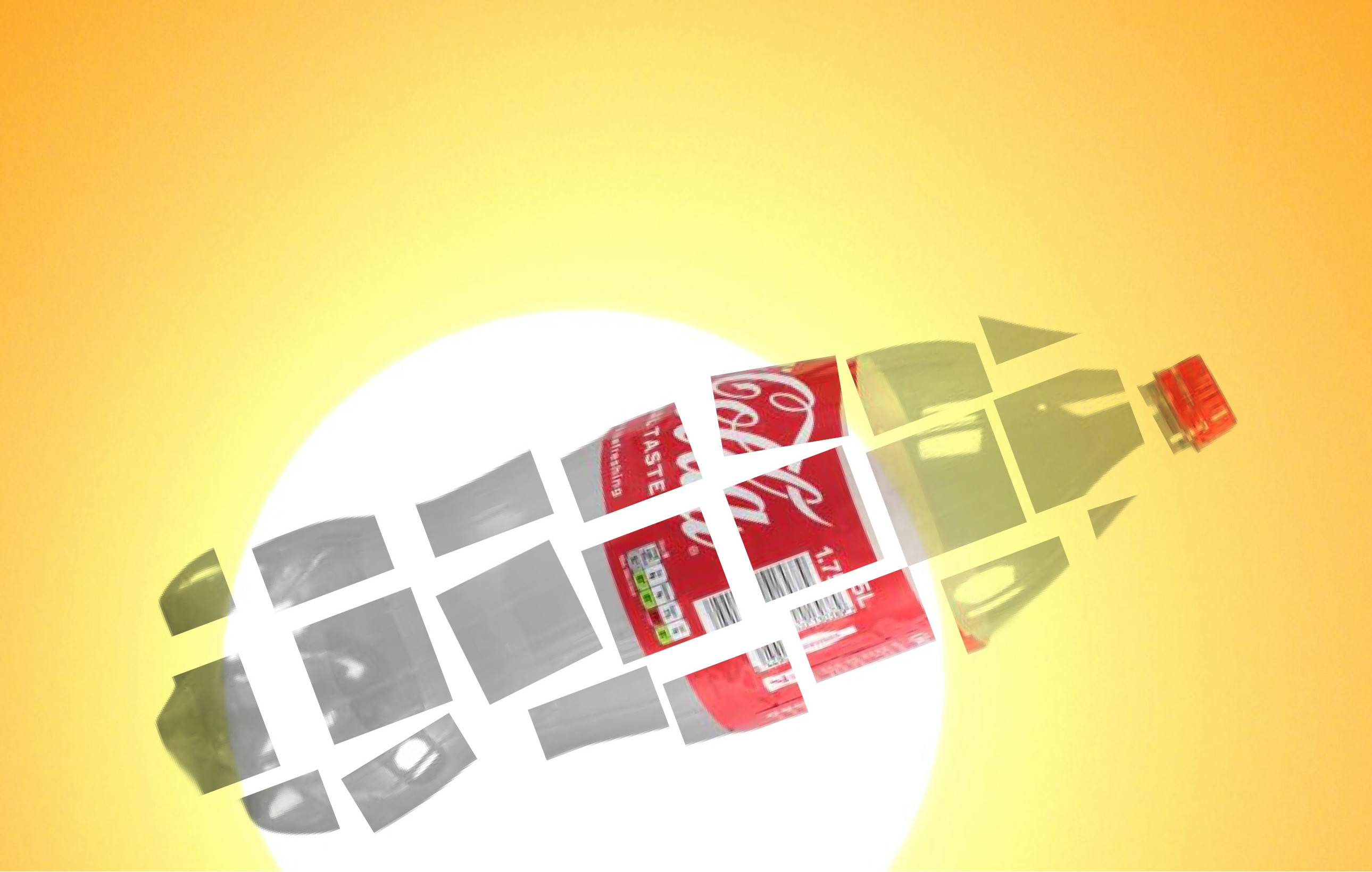
We have aimed our method at one of the costliest bottlenecks in plastic recycling.7 Breaking down PET (polyethylene terephthalate), the plastic in drink bottles and packaging, relies on a chemical called ethylene glycol, which must then be recovered and fed back in (see page 23). That recovery step alone can account for about 40% of the cost of the whole process. Our membranes pull the ethylene glycol back out of the leftover water at the high purity needed for reuse [5], and they can also strip out the dyes that bleed from coloured bottles. Clean the glycol up well enough, and it simply goes round again.
But that is only one plastic. With PhD student Laila Halim, we are extending the idea along the rest of the chain to other plastics. One membrane under development pairs a MOF-like crystal with a tough polymer film to fish styrene, the building block of polystyrene foam cups and packaging, out from its dimer. None of the eight commercial membranes against which we benchmarked it could do the same.
Another line of work purifies the recovered PET monomer itself; the best membranes we have tested so far already reach better than 93% purity, the quality that bottle-grade recycled plastic demands. These projects are still in progress, but all aim at the same target: making every sorting step in recycling cheaper and cleaner.
Get this right, and plastic waste stops being rubbish and becomes a feedstock, a raw ingredient for making new plastic, kept in a loop and out of the ocean. Chemists refer to this as a circular economy. You could also just call it not wasting things.
When recycling is not enough, upcycle
Sometimes, though, recycling a plastic back as itself simply does not pay. So now we are asking a bolder question: can waste plastic become something worth more than the original? In one project, co-supervised by Dr Declan McNamara, Laila is using waste nylon, the polymer in carpets, ropes and fishing nets, and spinning it into a mat of ultra-fine fibres that can act as an internal scaffold inside a lithium-sulfur (Li-S) battery, a lighter, potentially cheaper next-generation alternative to the lithium-ion batteries currently found everywhere from hearing aids to motor vehicles.
But these new Li-S batteries tend to fade quickly with use. In our early tests, the nylon scaffold holds the electrode together and slows that fade. It is early days, but the idea is appealing: yesterday's fishing net might help to store tomorrow's renewable energy (see page 8).
Why it matters for Victoria
Beyond cleaner water and safer food, there is a bigger opportunity here. Recycling plastic this way, rather than making it anew from fossil fuels, can cut the carbon emissions of producing plastic by around 90% and roughly halve the energy used in doing so. So better recycling is a way to lower Australia's emissions. And Australia is genuinely strong in the underlying science.
Four decades after Robson's insight, MOFs are one of the busiest fields in chemistry, with tens of thousands of frameworks designed worldwide. Victorian groups have stayed near the forefront rather than watching a homegrown idea flourish elsewhere. MOF-based companies are already spinning out of the CSIRO and universities, including Monash, so discoveries made in our labs can grow into local industries and jobs. Victoria helped invent these molecular sponges, and there is every reason for it to lead the pack in putting them to work.
Want to hear more about applied science in Victoria?
subscribe.rsv.org.au
References
[1] Ragusa, A. et al. (2021), Plasticenta: First evidence of microplastics in human placenta. Environment International 146: 106274. https://doi.org/10.1016/j.envint.2020.106274
[2] Garcia, M.A. et al. (2024), Quantitation and identification of microplastics accumulation in human placental specimens using pyrolysis gas chromatography–mass spectrometry. Toxicological Sciences 199: 81–88. https://doi.org/10.1093/toxsci/kfae021
[3] Organisation for Economic Co-operation and Development (2022), Global plastics outlook: Economic drivers, environmental impacts and policy options. OECD Publishing. https://doi.org/10.1787/de747aef-en
[4] The Royal Swedish Academy of Sciences (2025), The Nobel Prize in Chemistry 2025: Susumu Kitagawa, Richard Robson and Omar M. Yaghi.NobelPrize.org
[5] Mahdavi, H. et al. (2026), Towards cost-effective and sustainable PET recycling through glycolysis: Ethylene glycol recovery using solution-processable nanocomposite membranes. Chemical Engineering Journal 538: 176529. https://doi.org/10.1016/j.cej.2026.176529
[6] Banner image by Marc Newberry on Unsplash
Other articles of interest





Discover how you can join the society
Join The Royal Society of Victoria. From expert panels to unique events, we're your go-to for scientific engagement. Let's create something amazing.